Sunday, 29 January 2012

When Gracious Almighty Krishna was leaving the earth--

When Gracious Almighty Krishna was leaving the earth--

"Looking at Madhava, the Devas bowed down.
They gazed at the Form attentively;
Showered flowers on Him joyfully.

With folded palms, in separate groups,
They in devotion sang Krishna's deeds.
Some were doing Krishna's kirttana,
Some were dancing on to the tunes.
Instrumental sounds prevailed over sky;
Deva's beating of dundubhi rang high.
'Glory be to Krishna' was pronounced joyously.

Hearing sounds Hari looked above Him;
He met Brahma in front of Him.
Seeing other Devas too in front,
Almighty Krishna shut both eyes.

After performing yoga concentration all,
Placing Himself in Supreme Soul,
Leaving instantly the human nature,
Into Vaikuntha didst Hari enter.

As in clouds a lighting flash,
Is too fast for anyone to trace,
So also Krishna's speed of merger,
Was too difficult for Devas to discover.

The Body that was a meditating object,
Its sight made even Himself amazed.
Such a Body suddenly vanished,
As does the lightening flash.

Virtues like Beauty, Faith, Truth, Patience
With Krishna did all depart hence.
Seeing the happenings of the kinds,
Devas were stupefied in minds.

Wonderful was Krishna's yogic movement;
Seeing it Devas admired and were all content.
To King Parikshita Sage Suka said thus.
O king, won't be amazed at it;
Dead sons from Yama He brought,
As gift to Guru didst He offer;
As human to heaven He sent the hunter.

When by brahma-astra you were burnt,
He with Mace didst you protect.
Deva Hari, being the origin of all creation,
Didst not let survive the Yadu clan.

There is no smooth sailing in man;
Everything is disarrayed at the end.
Lord Hari didst demonstrate it;
Destroying the clan didst he depart.

It is one of the sportive deeds of Krishna,
One who chants about these always,
Surely in Vaikuntha does dwell;
Knowing it, give up idleness all.

Do Hari kirttana always;
Won't die by saying worthless words.
Krishna's kinkara Sankara thus says:
Ye all, chant hari-hari always."

(some verses from the Holy Bhagavata Purana)

Monday, 24 October 2011

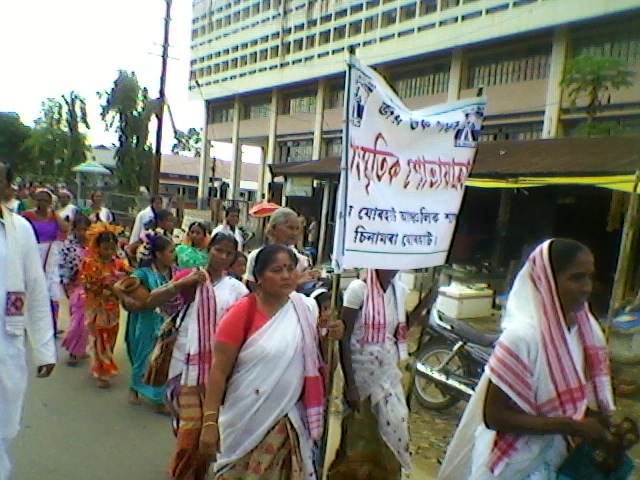
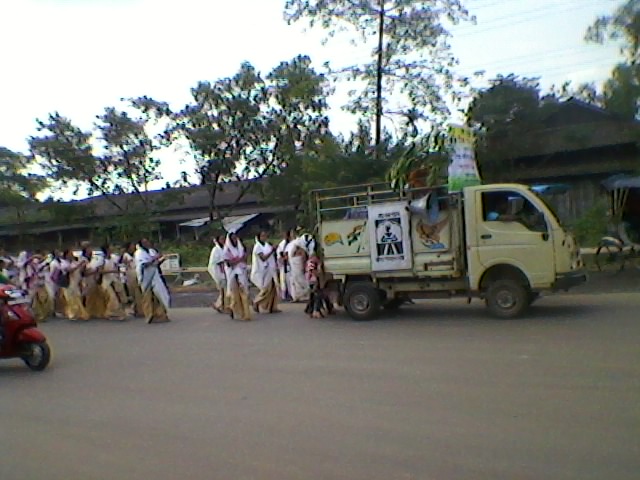
Celebrating 563 birth anniversary Of Mahapurush Srimanta Sankaradeva by Srimanta Sankaradeva Sangha

placing the Holy Bhagavata in the cart

ready to go

Bhagavata bhramana


procession

procession

procession

procession

kids in traditional dress

devotees singing Hari-naam

procession

procession

Unity in diversity. People from different communities marching together singing Hari-naam


People carrying banner of Jai Guru Sankara (Glory unto Guru Sankara)

procession

procession

procession

procession

procession

procession

Sunday, 25 September 2011

That outcaste is deemed to be greatest:
From whose tip of tongue flows Hari's message;
He has earned virtues all of holy baths,
Penances, fire-offerings and charities.
To best of castes he belongs, understands Vedas,
If from his mouth springs Hari's naam.

If in Krishna-katha a person has deep interest,
He need not aspire to be a Brahmana in birth.
Let him only recall Hari day and night,
Devotion makes no distinction between caste uncaste.

Thursday, 4 August 2011

Our Guru Srimanta Sankara

"Srimanta Sankara Hari Bhakatara
Jānā yena kalpataru
Tāhānta bināi nāi nāi nāi
Āmāra parama Guru ." 375(Naam Ghukha)

Know ye that Srimanta Sankaradeva is like the wish-yielding tree (kalpataru) of all the devotees of Hari. Be triple sure that there is no (other) Guru than Sankaradeva himself.

Saturday, 30 July 2011

The Holy Scriptures


“First do I bow down unto Thee, O Sanatana Narayana;
Thou art Brahma manifest, the cause of all incarnations.
From Thy Lotus-naval Brahma sprang forth;
Innumerable Incarnations through ages Thou hadst. ”
            _1 (kirttana ghukha)
The Lord Almighty Narayana is the creator. He is pervading the world over. Everything that we see around us is created by the gracious Lord. The Lord created everything, moving and non-moving, and entered into all the bodied forms in form of soul. In Vedastuti, the Vedas are thus praying at the feet of Lord Narayana:
“Thou hadst created all forms- moving, non-moving;
Thou art with all Greatness present in everything.
Entered Thou as soul into all bodied forms,
Hence, we worship Thee by all means.”
_1655 (kirttana ghukha)
To save the world, for the welfare of the noble and to make the truth prevail the Gracious Lord takes innumerable incarnations from time to time. The various incarnations of Lord Vishnu reminds us of the evolution of life in earth, starting from matsya (fish) avatar to the much awaiting Kalki. In each incarnation the Master, the Almighty Narayana had taught us different lessons in a very sportive way. And the Holy Books like the Kirttana ghukha, Naam ghukha, Srimad Bhagavat Gita etc. contains these lessons that the Lord had taught us. In other words, these books contain the words spoken by the Gracious Lord. In the kali age these holy books are our only preceptors, our only guru. These books would always guide us on the correct way. It is given in the Prahlada Charitra (The Episode of Prahlada) that Lord Almighty could not be achieved through sacrifice, penance, rituals and knowledge. The Gracious Lord could be won only through true devotion (bhakti). The great devotee Prahlada had thus said-
“For devotion one need not be God, dvija, sage;
One need not acquire knowledge of many scriptures;
Penances, silent prayers, sacrifices, gifts are mere deceptions,
Narayana remains content only with devotion.”
_Prahlada  Charitra
However, devotion does not come automatically. To develop devotion one must have to go on practicing it in body, mind and words.
For practicing devotion at Lord Krishna’s lotus feet the company of Vishnu’s devotee is required first. Vishnu’s devotee should be taken as preceptor and well treated. And in our times it is a painful truth that the society is developing for sure however, it is also degenerating as well at the same time. And we, the people, are so sinful that today it is very hard to find a Vaishnava i.e. a true devotee of Lord Vishnu who could guide us. However, if we search by heart we would find the company of Vishnu’s devotee for sure, and this company is in the form of the holy books like the Holy Kirttana ghukha, Naam ghukha, Srimad Bhagavat Gita etc. We should take these Holy Scriptures as our preceptor and treat them well. They are the only company of Vishnu’s devotee. 

Friday, 29 July 2011

Mahapurus Srimanta Sankaradeva


Mahapurusha Srimanta Sankaradeva (1449–1568) saint-scholar, playwright, social-religious reformer, is one  of the greatest religious leaders India has ever produced. The saint led the medieval Bhakti-movement in the north-eastern part of India and founded a religion named Eka-sarana Hari naam dharma. He is credited with providing a thread of unity to Assam straddling two major kingdoms (Ahom and Koch kingdoms), building on past literary activities to provide the bedrock of Assamese culture, and creating a religion that gave shape to a set of new values and social synthesis. The religion he started, Mahapuruxiya Dharma was part of the  Bhakti movement then raging in India, and he inspired bhakti (devotion) in Assam just as Ramananda, Guru Nanak, Kabir, Basava and Chaitanva Mahaprabhu inspired it elsewhere.
His literary and artistic contributions are living traditions in Assam today. The religion he preached is practiced by a large population, and Sattras (monasteries) that he and his followers established continue to flourish and sustain his legacy.
Sankaradeva took his birth in 1449 in Siromani Bhuna family at Alipukhuri near Bardowa in the present district of Nagaon, Assam. He lost his parents at an early age. He was admitted to school at the age of twelve and after seven years came out as an “unerring scholar”.
On returning home Sankaradeva had to accept the Siromani Bhunaship. He got married at the age of twenty-one or so. But he was more inclined to the study of religious scriptures and ultimately propagated the Bhakti cult. At the age of thirty-two he went on a twelve years long pilgrimage with seventeen companions and visited most of the Vaishnava centres in India. Thereby he came into direct interaction with the nascent neo-Vaishnava movement. He saw the mission launched earlier in a proper perspective and also the means of realizing that.
After completing the pilgrimage, Sankaradeva returned home in 1493. He renounced the post of Siromani Bhunaship and made all arrangements for the propagation of his faith. However, under the pressure of his kinsmen, he had to marry again a Kayastha girl, named Kalindi.
Sankaradeva had to leave his ancestral home in the Bhuna-territories in 1516 A.D. owing to the clash with the neighbouring Kachari tribes. With his kinsmen and followers he shifted the residence to different places on the northern bank of the river Brahmaputra and finally got settled in 1522 A.D at Dhuwahat-Belaguri of Majuli, the river island, in the Ahom kingdom. It was here that, in 1522 A.D, Sankaradeva initiated Madhavdeva into his faith. Madhavdeva had been an young and exuberant pandit of Sakta faith, but after initiation h become the greatest apostle of his guru.
But soon the religion propagated by Sankaradeva proved to be a challenge to the existing Brahmanical priesthood. The priestly class naturally grew hostile to Sankaradeva, abusing and molesting his followers. They started lodging false allegations in the Ahom court against Sankaradeva resulting ultimately, under some pretext, in the tragic beheading of Sankaradeva’s son-in-law, Hari and the imprisonment of Madhavdeva for about a year.
Being shocked and hurt by this inhuman incident, Sankaradeva made up his mind to leave the Ahom kingdom. In the meantime, he heard that the King Naranarayana of Koc-Behar was a scholar and a poet also. Hoping for King Naranarayana’s patronage, Sankaradeva with his followers sailed down the Brahmaputra in 1545 and landed at Barpeta in Kamarupa under the Koc king. Sankaradeva finally settled down at Patbousi in Barpeta for the last eighteen or twenty years of his life. Here he secured the patronage of Cilaraya, the brother and commander-in-chief of the king Naranarayana, as a daughter of Sankaradeva’s cousin Ramraya was given in marriage to Cilaraya. Then Sankaradeva found another rich and sagacious devotee, named Bhavananda Saud (renamed as Narayana Das Thakur). His religious order thrived much there.
In about 1550, Sankaradeva set out for his second pilgrimage with 120 followers, including Madhavdeva and others. The pilgrimage took only six months and extended upto Puri only.
In the Koc kingdom, Sankaradeva’s new cult grew to its fullness. The old priestly class alleged to king Naranarayana against the teachings of Sankaradeva. The king ordered Sankaradeva to appear in his court. Sankaradeva appeared in the court in 1558. The king was overpowered by the radiating personality, sublime faith, profound scholarship and high  poetic accomplishment of Sankaradeva. The Guru came out triumphant in the series of debates that ensured with the Brahmana pundits. The king turned a liflong bosom friend of Sankaradeva and under his patronage Sankaradeva’s cult grew vigorously.
In the last few years of his life, Sankaradeva kept shuttling between Patbousi and Koc-Behar. His eventful long life came to an end in Koc-Behar in 1569. Then Madhavdeva, Sankaradeva’s nominee, shouldered the headship of the religious order.

Thursday, 28 July 2011

Don't waste your time in getting the rituals done... Leave all aside and practice devotion through Sravana and Kirttana


Becoming a Vaishnav i.e., a devotee of Lord Vishnu is not easy. Devotion in the Lotus Feet of the Almighty is required.
To be honest, in todays world nobody could be a Vaishnav. All we sinful could do is to try to be a Vaishnav by taking refugee at Lord Narayana's feet by body, mind and word, and practicing devotion through sravana and kirttana of Hari-naam.
Today, people attach more importance to rituals etc. However, always keep this in mind that one could not be a Vaishnav by birth. One could be a Vaishnav only and only through devotion. Little devotion is not enough; Infinite devotion is needed. Every thing like wearing kanthi, being a vegetarian, etc. etc. are absurd, without devotion even taking diksha is useless.

Thus, if one has the desire to be a devotee of Almighty Hari, first practice devotion through sravana and kirttana of Hari-naam.

(never be confused with the name of the Almighty because the Gracious Lord has different names. Just know it well that Lord is the same)